
Introduction
This article is the third instalment in a series examining the growing importance of artificial intelligence for land command and control. The first article, “Artificial Intelligence on the Battlefield: Findings and Requirements for Enhancing Capability in Land Operations”, published in Hardthöhen-Kurier 5/2025, analysed the potential and limits of AI systems on the battlefield, drawing on lessons from the war in Ukraine and the resulting requirements for the German Land Forces. The second article, “The AI-Enabled Command Post: A Central Element of AI-Centric Command and Control”, published on novumbellum.org in January 2026, developed that line of thought further and outlined a conceptual approach for integrating generative AI into dispersed command-post operations. This article carries both predecessors through to their logical conclusion and makes the decisive step from AI-enabled to AI-centric command and control.
The difference is fundamental. AI-enabled command and control means that artificial intelligence supports humans in individual tasks, one tool among many, employed selectively and selectively effective. AI-centric command and control means that AI becomes the organising element of the entire command architecture. It permeates intelligence, command and control, effects, and support not as an add-on, but as the connective nervous system. Humans remain the decision-makers, but the way they arrive at decisions changes fundamentally.
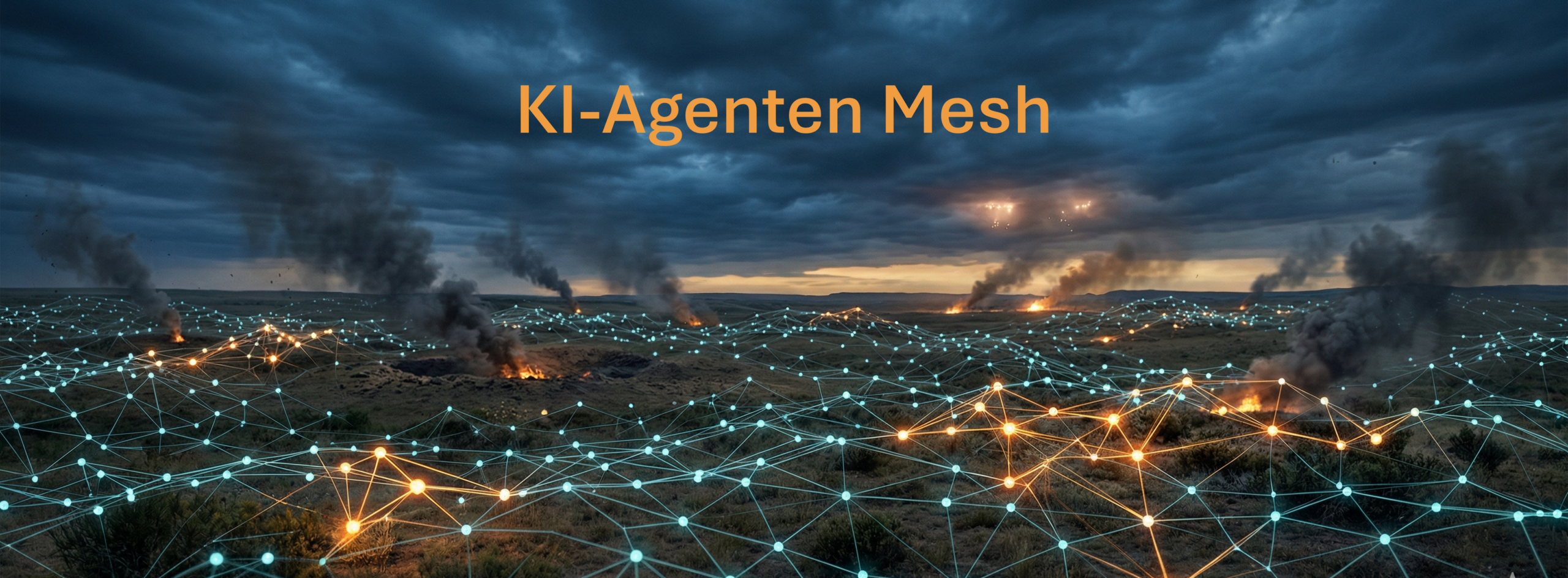
The core of this article is the concept of the AI agent mesh: a self-organising network of specialised AI agents spanning the full depth of the battlespace, from the sensor on a drone to the command vehicle to the operational command post. The article describes where AI development stands today, what the AI agent mesh means in concrete terms, technically, geographically, and organisationally, how other nations are already moving in this direction, and what action the Bundeswehr must now take.
The Current State: From Agentic to Multi-Agent Systems
Since the release of ChatGPT at the end of 2022, the development of artificial intelligence has reached a pace that has surprised even specialists. Within just three years, generative AI systems have evolved from cloud-based text generators into autonomous agents capable of executing complex tasks independently, using tools, and interacting with other systems. The current paradigm shift is taking AI from individual models to networked multi-agent systems in which several specialised AI agents collaborate through a division of labour and produce an outcome that none of them could achieve alone. That this shift has also been recognised militarily is evident in the US Department of Defense AI Strategy published in January 2026, which explicitly identifies agentic networks as a priority area.
A striking example of the potential of such systems is provided by civilian open-source projects such as OpenClaw and Hermes Agent, which since late 2025 have attracted hundreds of thousands of developers worldwide within just a few months. These are agentic frameworks that run on local hardware, connect different communication channels, and autonomously perform complex computer-based tasks, either with cloud access to powerful language models or entirely locally with smaller models. What these projects demonstrate in the civilian context is of immediate conceptual relevance in the military domain: they show what self-organising networks of AI agents are already technically capable of today.
At the same time as multi-agent systems are emerging, AI models themselves are undergoing a decisive leap in efficiency. They no longer necessarily depend on gigantic cloud-based data centres. New generations of models are optimised to deliver maximum speed with minimal resource consumption and without cloud connectivity. For military use, this points to a clear division of labour: large language models with extensive reasoning capabilities at the strategic and operational levels, mobile AI clusters at tactical command posts, and specialised small models directly on the edge device.
The Core Vision: The AI Agent Mesh
The first article in this series touched on an idea that still seemed speculative at the time, but which must now be taken seriously as a conceptual guide: in future, the Bundeswehr could deploy hundreds, if not thousands, of different AI agents. Virtually every sensor, every weapon system, every combat vehicle, every command and control node would have specialised AI agents. In combat, these systems would interact autonomously, exchanging data and insights automatically, without requiring human intervention.
That is precisely the picture described by the AI agent mesh, the core vision of this article. The mesh is not a single system and not a centralised programme. It is an end-to-end, self-organising network of specialised AI agents spanning the full depth of the battlespace, from the lowest tactical level to the operational command post. Every node in this network is an actor: it ingests information, processes it, makes limited autonomous decisions within its remit, and passes consolidated insights to adjacent nodes.
What this means in practice can be illustrated through a concrete scenario. An ISR drone identifies an enemy vehicle. Its embedded AI agent classifies the target, assesses the threat situation, and no longer reports that insight vertically to a higher headquarters. Instead, the sensor agent negotiates in a decentralised and immediate manner with the autonomous AI agents of nearby effectors regarding available fire capacity. The selected artillery agent autonomously takes over target allocation and prepares the fire mission, in seconds rather than minutes. At the same time, a third agent automatically informs the logistics chain of the ammunition expenditure that a possible engagement would entail. All of this happens in parallel, without serial relay through human intermediaries, without traditional reporting chains, and without delay.
Taken in isolation, this scenario is an improvement, but not yet a transformation. The real paradigm shift occurs when this happens not once, but a thousand times simultaneously, when hundreds of sensors across a major formation are evaluated in real time, when dozens of command posts receive a current operational picture at the same time, and when the sensor-to-shooter loop is closed across the entire sector without manual reporting procedures. Authority to engage remains with the human commander at all times.
What matters most is this: the mesh is more than the sum of its parts. Each individual AI agent solves a limited task. Yet taken together they generate a synergistic effect that makes the overall system many times more capable than any single agent on its own, a collective intelligence across the battlefield that no single system and no human staff could match in this speed and breadth. Only at this scale does the AI agent mesh achieve its full effect, and only then does command and control shift from AI-enabled to AI-centric.
The AI agent mesh is not a conceptual new beginning. It is the land-tactical counterpart to an idea the US military has been developing systematically for years: the kill web. Through JADC2, DARPA’s ACK programme, and Project Convergence, the United States is networking sensors and effectors across all domains, air, land, sea, space, and cyberspace, and replacing linear kill chains with resilient, decentralised networks. What is being conceived there at the multi-domain level, the AI agent mesh carries through to its conclusion at the level of the Land Forces. Armed forces that fail to take this step do not lose the speed advantage in some abstract future, they are already losing it today.
The Technical Dimension: Infrastructure for the Mesh
The technical building blocks for an AI agent mesh already exist, on the civilian market, not within the Bundeswehr. For the armed forces, this creates a classic dual-use situation: the technology is available, but the path to a fieldable, integrated system is neither short nor straightforward. The mesh’s basic technical structure follows a layered approach derived from the reality of current conflicts.
At the tactical edge, where contact with the enemy occurs, the war in Ukraine has fundamentally changed the battlefield. In many sectors, classic armoured platforms can scarcely manoeuvre without being detected and engaged immediately. Drones account for up to 75 per cent of combat losses on both sides. Today the forward edge is dominated by ISR drones, FPV attack drones, loitering munitions, ground-based sensors, and dismounted soldiers, systems that are small, networked, available in large numbers, and individually expendable. This zone constitutes the lowest layer of the AI agent mesh. Here, small specialised AI models are employed on edge hardware: image recognition directly on the drone, target classification at the sensor, command support on the soldier’s smartphone. Everything is local, without cloud connectivity and without reach-back to the command post. The computing power required for this is already available today in commercial off-the-shelf devices.
At platform level, in armoured combat and support vehicles of all types, role and employment profile are shifting. Armoured platforms are increasingly operating from depth, as protected firepower and mobile command assets, no longer as the spearhead on the forward line. Their AI requirements are therefore different: simultaneous processing of sensor data, situational information, and tactical decision support in a single vehicle-capable computing module. Powerful civilian solutions already exist for this as well. The real challenge lies in military adaptation, ruggedisation, certification to military standards, and integration into existing vehicle systems.
At command-post level, the focus shifts from pure data processing to AI-enabled decision support. Dispersed command-post cells must consolidate operational pictures under time pressure, simulate courses of action, and present assessed options to the commander, tasks that require powerful AI systems with extensive reasoning capabilities. Since 2025, a new class of compact AI computers has come onto the market, delivering near data-centre performance in the form factor of a mini PC. Several such systems, connected as a mini-cluster, could provide the computational basis for voice-based, agentic command support of the kind conceptually described in the second article of this series.
The connecting principle across all three layers is this: AI processing takes place where the data is generated. Only consolidated insights are transmitted, not raw data. A single ISR drone generates more than 100 gigabytes of sensor data per mission, and at battalion level this amounts to terabytes per day. Under combat conditions, these data volumes cannot be transmitted. They must be processed where they are produced.
The Geographical Dimension: Home Base, Theatre, and Connectivity
The AI agent mesh does not end at the forward edge. It extends, in different forms and with different requirements, from the battlefield back to the home base. Where computing power is provided, which models are run where, and how connectivity between theatre and home base is ensured are not downstream infrastructure issues. They are planning parameters that must be defined early, because the operational requirement at each level determines computing demand, model size, and transmission requirement.
In theatre, sensors, platforms, and command posts operate according to the layered principle described in the previous section, autonomously, on local hardware, with specialised models for their respective tasks. The further one moves from the tactical edge into the rear, the more computing power becomes available, the larger the models become, and the more comprehensive the decision support they can provide.
At home base, the heavy AI infrastructure is concentrated. This is where large language models are trained, updated, and optimised for operational use. This is where the systems required for strategic and operational decision support are run, models that are too large and too power-hungry for mobile deployment, but which realise their full effect at this level.
Military AI data centres are subject to requirements fundamentally different from those of civilian infrastructures. They must be physically protected, designed with redundancy, and hardened equally against cyber attack and kinetic threats. The EuroHPC Initiative is indeed building a powerful European high-performance computing landscape, but these systems are civilian by design, operated at civilian sites, and neither intended nor suitable for military purposes. AI-centric command and control would require an independent, protected military computing infrastructure.
Directly linked to this is the question of digital sovereignty. Which AI models are running in German data centres? Under what conditions were they developed? Who has access to the training data? At present, Europe has only one actor that is seriously competitive in this field: the French company Mistral AI, which develops powerful language models with a clear claim to European data sovereignty and already holds a framework contract with the French Ministry of the Armed Forces.
The connection between home base and theatre is the third element, and perhaps the most technically demanding. In a resilient mesh architecture, however, it does not function as an uninterrupted umbilical cord for day-to-day combat operations, but rather serves periodic higher-level synchronisation. Whenever communications links to the rear are available, operational pictures and decentralised training data collected in theatre flow back to the home base. There they can be used for the continuous improvement of the large foundation models, before substantial model updates are transmitted back into theatre.
The Organisational Dimension: What Changes in Command and Control?
Technology changes command and control only when it is translated into organisation. The AI agent mesh is no exception. Its real effect derives not from the hardware on which it runs, but from the changes it produces in the way command is exercised, decisions are prepared, and orders are issued.
At the operational level, the Bundeswehr Joint Forces Operations Command offers considerable potential for the use of AI-enabled command support systems. It maintains the joint operational picture around the clock, translates strategic guidance into concrete military tasks, and prioritises the forces and capabilities to be made available, serving since April 2025 as the central hub between the Ministry of Defence, the services, and the support command. This task profile is exactly where AI agents provide the greatest immediate added value: automated fusion of operational pictures from hundreds of simultaneous sources, simulation of courses of action in minutes rather than hours, and a continuous resource overview without manual maintenance effort.
The centre of gravity of the mesh, however, lies at the tactical level, from division to brigade to battalion and below. Here time pressure is greatest, data volume is highest, and the consequences of delay are most immediate. At the same time, this is also where humans are still under the greatest burden today: staff officers manually aggregate reports, commanders wait for situational pictures that are already outdated when they arrive. The digitisation of land-based operations provides the digital foundation for this. Yet it will realise its full potential only if it is aligned from the outset with the integration of AI capabilities and with new, more decentralised command structures.
AI-centric command and control does not mean digitally accelerating existing staffs, but structurally adapting the command organisation. The operational value of a gradual decentralisation of traditional staffs in favour of smaller, more agile command nodes should therefore be examined intensively in upcoming tests and trials. In future, the commander will no longer be presented with a manually fused operational picture, but with a course of action optimised by AI agents. The commander remains in command, but from an adapted structure, with a significantly reduced cognitive burden and at the tempo of highly mobile operations.
The Bundeswehr is already taking initial concrete steps in this area. Through the ReLeGs study, the Army Development Office is examining how reinforcement learning can be used for decision support at battalion level, an AI system that assesses the prospects of success of courses of action and provides tactical recommendations before the commander makes a decision. In parallel, through the KITCH study, the Bundeswehr Support Command is examining whether a voice-based AI interface can be integrated into the command post, relieving staff officers of time-consuming application handling and enabling them to interact with the operational picture in natural language. Both studies have demonstrated the basic feasibility of their respective approaches. The conceptual groundwork has been completed, but they have yet to be matured for service use.
International Comparison
A look at allies shows that AI-centric command and control is not an abstract vision. The United States has fielded the Maven Smart System, an AI-enabled data integration and operational picture platform that fuses ISR data from hundreds of sources, shortens decision cycles, and is being rolled out across NATO headquarters. The United Kingdom is driving operational AI integration through the Defence AI Centre and is examining AI-centric command structures for high-intensity warfare in concept studies. France is taking the most consistent European approach: with the military AI agency AMIAD, a dedicated defence supercomputer, and the ARTEMIS.IA C2 programme, Paris is building sovereign infrastructure for AI-enabled command and control on the battlefield.
At multinational level, resources from the European Defence Fund are being used to advance the convergence of AI and command systems in a targeted manner. The ongoing PROTEAS project is examining the development of AI-enabled, deployable command posts with federated data fusion. In addition, the EDF Work Programme 2026 calls for the development of a European AI framework for military decision-making. The objective is to break up isolated national solutions and place interoperability within the Alliance on a new technological footing.
Against this backdrop, the Bundeswehr still has considerable ground to make up, though not without direction. At the conceptual level, the ReLeGs, KITCH, AUGE, and KITU studies are examining various AI application areas, ranging from decision support and automated terrain analysis to the swarm control of tactical drones. At the operational level, Uranos KI is becoming the first AI-enabled ISR system for tactical employment. And with the innovation centre opened in Erding in February 2026, the Bundeswehr has for the first time created an institutional home tasked with accelerating the transfer of civilian high technology, including AI, into military use.
Conclusion
AI-centric command and control is an operational necessity, and its technological foundations already exist today. AI is ceasing to be one tool among many. It is becoming the organising nervous system of the entire command architecture. The AI agent mesh is not an infrastructure project, it is a command model. Whoever introduces it determines how responsibility is distributed, how operational pictures are built, and how decisions are prepared, from the top down.
The geopolitical situation demands rapid action. Allies are already operational, technologies are available, and the pressure is growing. All the more important, then, that the path now taken follows a clear target model from the outset. Isolated solutions without a conceptual framework, procurement without an architectural concept, and pilot projects with no follow-on path are risks that a future-oriented military cannot afford. Bold decisions require orientation, not as a brake, but as a compass.
For this idea to remain more than a concept, institutional spaces are needed where operational need and technological possibility can come together. The studies conducted by the Bundeswehr Support Command, the Army Command, and the Army Development Office, together with the innovation centre in Erding, are such spaces. What is decisive is that they be aligned consistently with the target model of AI-centric command and control. Anyone who wants to retain the initiative on the battlefield of the future must master the AI agent mesh. The time to build it is now.