
Command Under Fire and Information Pressure
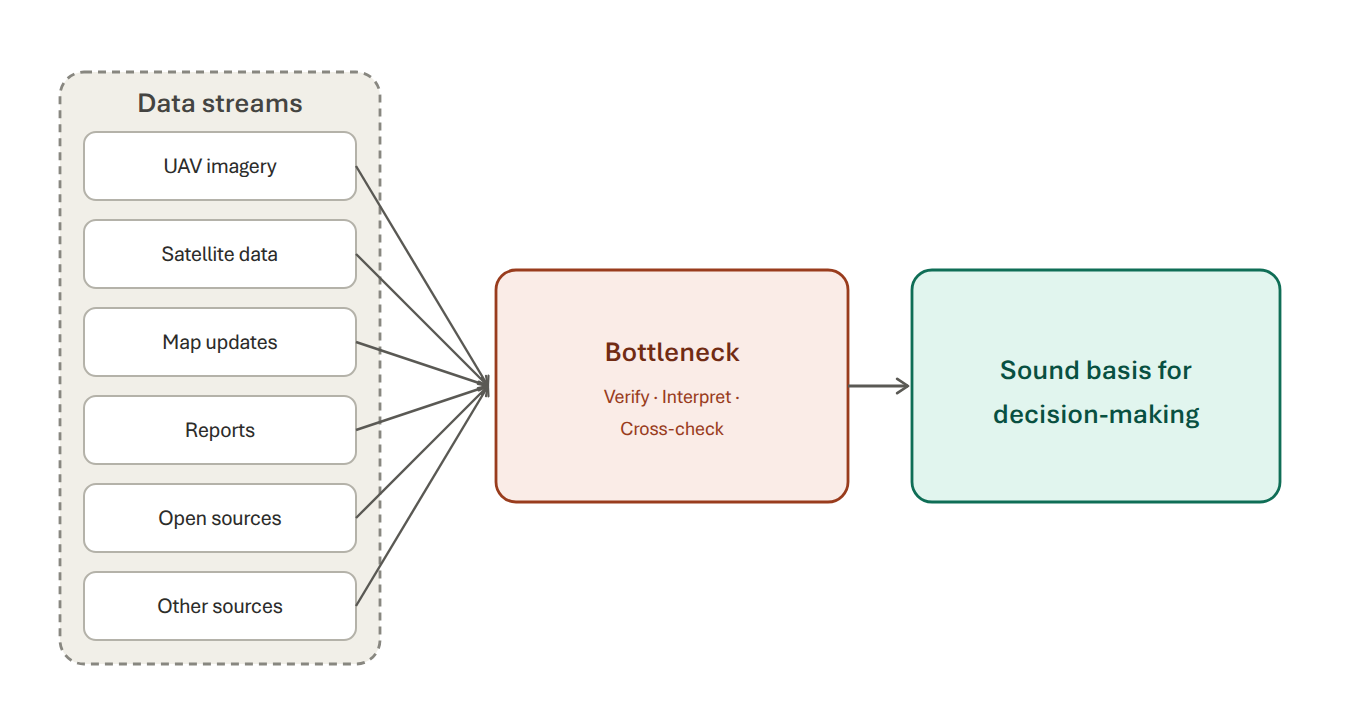
Bakhmut, spring 2023. One of the war’s most costly battles has been raging around the city for months, with artillery fire rarely letting up. A few kilometres behind the forward line, a small Ukrainian staff operates from a command post. Russian reconnaissance searches for command-and-control facilities of this kind because, once detected, a command post becomes a high-value target for artillery and missiles. The pressure of combat is intense, yet there is no shortage of situational information. A high-capacity broadband satellite communications system provides the staff with a detailed and continuously updated picture of the battle.
Once this picture is available, the command post’s real work begins. From the continuous flow of incoming information, the staff must establish and assess the situation, prepare decisions and update orders, keeping pace with the battle rhythm while racing against the adversary. These are precisely the functions that come under pressure. Areas of terrain are attributed to the adversary even though friendly units still hold them. Newly reported targets are engaged immediately when they should first have been weighed against more serious threats. The volume of reporting is manageable. What the staff lacks is the time to reconstruct, at each step, the relationship between the situation, the mission and the work completed so far.
Whether the staff retains the initiative depends on how quickly it reaches a sound result at each stage of its command-and-control activities. This is where artificial intelligence (AI)-enabled decision support comes into play. Rather than merely filtering the flow of reports, it provides focused assistance throughout the decision-making process. During situation development, it keeps the current body of work available; during assessment, it identifies important assumptions and contradictions; when a decision is taken, it makes the rationale visible and carries it forward into orders and handovers. To do so, the AI system must recognise the provenance, status and function of the information it processes.
Continuity and Change in Command-Post Operations
The following considerations concern formation-level command posts, particularly those of brigades and divisions. At this level, planning and current operations are closely interwoven and form a continuous command-and-control process. The command post functions through a division of labour, while the battle rhythm synchronises the work. Situation briefings, boards, interim meetings, planning phases and handovers bring its various strands together at the required time. The cells produce specialist input, which the Chief of Staff (COS) and the command-and-control organisation synchronise and consolidate into a decision-ready basis for the commander.
The fundamentals of this work have not changed. The decision-making process, from establishing the situation to issuing orders, shapes command-post operations today just as it did in the past. Nor is distributed staff work across dispersed locations a new development. Until the 1990s, division command posts were routinely spread across a small village, with their cells and centres accommodated in buildings and barns. Information requirements cannot be defined in absolute terms either. How much information is sufficient depends on the mission, the situation and the decision-maker. Uncertainty remains a defining characteristic of command.
What has changed is the information base. As the conduct of operations becomes increasingly digital, the volume, velocity and heterogeneity of available information continue to grow. Its digital processing has long been part of everyday staff work. Unmanned and autonomously operating reconnaissance and loitering systems increasingly contribute to this growth by detecting and reporting targets automatically. AI-enabled processing adds a new dimension. It captures both what a document contains and what it means and, working alongside the staff, can generate input for every phase of the decision-making process. Superior command-and-control capability comes from disciplined synthesis and the resulting time advantage, not from an abundance of data.
The Challenge: Preserving Context in the Decision-Making Process
Disciplined synthesis requires the AI to understand the relationship between the situation, the mission and the work completed so far, just like anyone else working within the staff. Preserving this context is difficult. The decision-making process organises command-post operations into clear steps, but the work itself remains dynamic. Cells work in parallel, planning and current operations interact, and assumptions change. Decision points are not static either; they emerge, shift and become obsolete as the battle develops. Even disciplined staff work may leave uncertainty as to which version is authoritative, which assumption was made and which conclusion remains relevant to the next decision point.
Command and control information systems (C2IS) address only part of this problem. They integrate data and support a common operational picture. The second level, which is decisive for the staff, consists of professional military interpretation. It resides in what the staff has assessed, coordinated and ordered, and above all in the rationale behind those actions. Displaying, storing or searching information cannot replace this level. Context becomes blurred when that interpretation can no longer be traced at the pace of command-post operations. The underlying work has not been lost, but its significance must repeatedly be re-established under time pressure. What formed the basis of the decision? What is obsolete? What remains unresolved, and what adjustment is required?
This brings the staff’s work products, including files, directories and cell input, into focus as the means by which this command context is preserved, rather than as mere storage. The staff may maintain orderly directories and still reach its limits as data volumes, formats and successive versions continue to proliferate. The decisive question is no longer simply whether a document exists. What matters is whether its relationship to the situation, the mission and the work completed so far remains recognisable at every stage of the decision-making process, both to the staff and to the AI. When those relationships remain visible, the AI can provide consistently better-founded support. This is the point at which AI-enabled knowledge management for command-post operations begins.
The Knowledge Architecture of Command-Post Operations
This form of knowledge management requires the AI system to have access to all three elements of the knowledge base. Doctrinal knowledge is authoritative and comprises the regulations, procedures and principles of command that apply irrespective of the specific situation. Situational information describes the current situation and is continuously updated by reports from the force, reconnaissance assets and adjacent units. Reported data remains information until the staff verifies and assesses it. Staff-generated knowledge is developed through the staff’s work. It comprises assessments, assumptions and rejected courses of action as well as decisions, orders and directives, whether they originate in the command post itself or at higher headquarters.
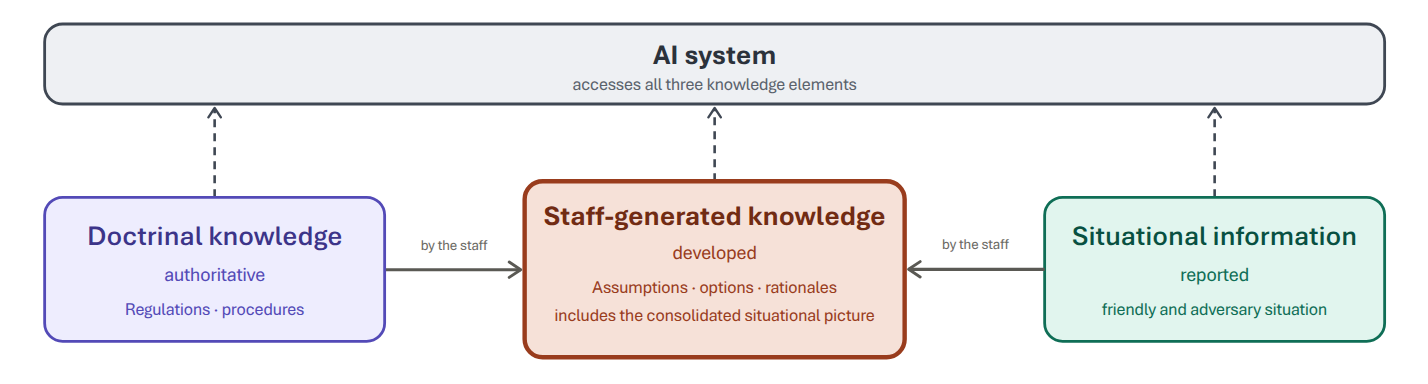
Access to these three elements has reached different levels of maturity. Doctrinal knowledge is already accessible, while connections to the relevant subsystems can expose situational information. Staff-generated knowledge, however, remains inaccessible. An AI can already open every file held by the staff and read its contents, but it cannot infer how those contents relate to one another because the documents do not express those relationships.
The files themselves must therefore retain these relationships. An automated process, rather than an additional staff task, creates the AI-readable situation and staff-work directory. For each document, it records provenance, status, ownership and approval. The directory also exposes substantive relationships, such as the link between a measure and the assumption on which it is based. Only AI can identify and maintain such relationships automatically.
Some staff-generated knowledge is contained in graphical products, including synchronisation matrices and decision-support products. Their meaning is not yet accessible to AI. Making these products machine-readable is an important further step in development.
The civilian sector is already implementing what is described here. Companies face the same challenge: their AI systems must connect to work in progress, including project status, decisions and rationales that develop across departments and over time. Solutions for individual users are already in use, while open-source implementations are available for teams of several dozen people. Google has released the underlying file format as an open standard, and Microsoft and Amazon are developing corresponding services.
The potential benefit for command-post operations is considerable. The staff continues to work in its familiar environment, while the AI reads the same directories and thereby gains access to staff-generated knowledge. It can reconstruct the relationships required for the decision-making process, making its support more relevant and reliable.
AI Support Throughout the Battle Rhythm
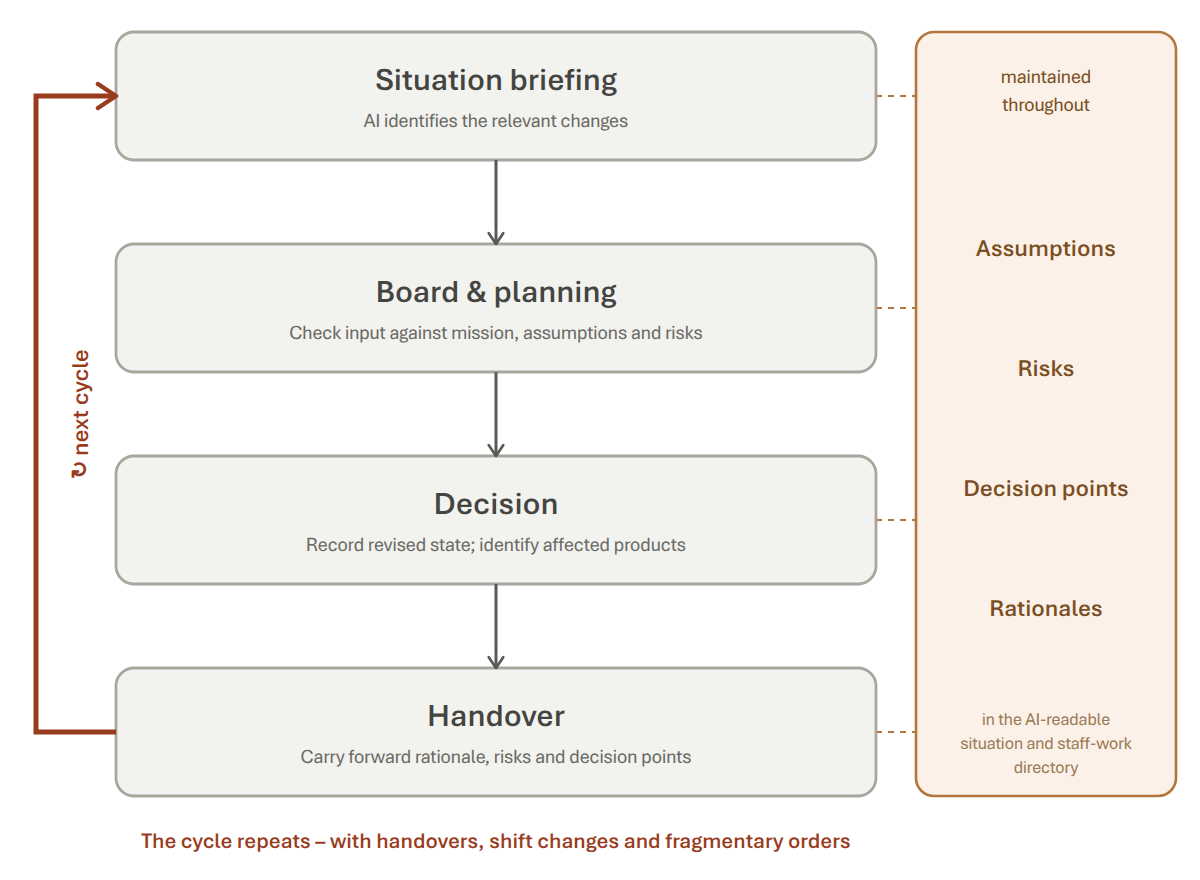
AI performs a different function at each point in the battle rhythm. Before a situation briefing, it identifies what has changed since the previous update. During boards and planning meetings, it checks the cells’ input against the mission and assumptions and flags discrepancies. Once the commander has made a decision, it records the revised state and identifies the products affected by it. During a handover, it explains how the plan was developed.
Under combat conditions, this support is not a matter of convenience. Faulty handovers, assumptions that have not been updated or changes in the situation that have been overlooked can put forces at risk and delay time-critical decisions.
The staff remains in control throughout. It tasks the AI system, reviews its output, requests revisions, rejects results and decides what enters the staff process. The work proceeds through an iterative exchange of tasking and support, whose scope depends on the situation, the level of command and the resources available.
Deploying a capable model at the command post is not enough. It can answer questions, summarise documents and make doctrinal knowledge accessible. These functions are useful, but their contribution to command and control remains limited. Operational value emerges only when the AI system connects to staff-generated knowledge, follows the battle rhythm and is embedded in staff procedures. This constitutes deep integration into the decision-making process, not merely the procurement of a model.
The Data Integration Platform
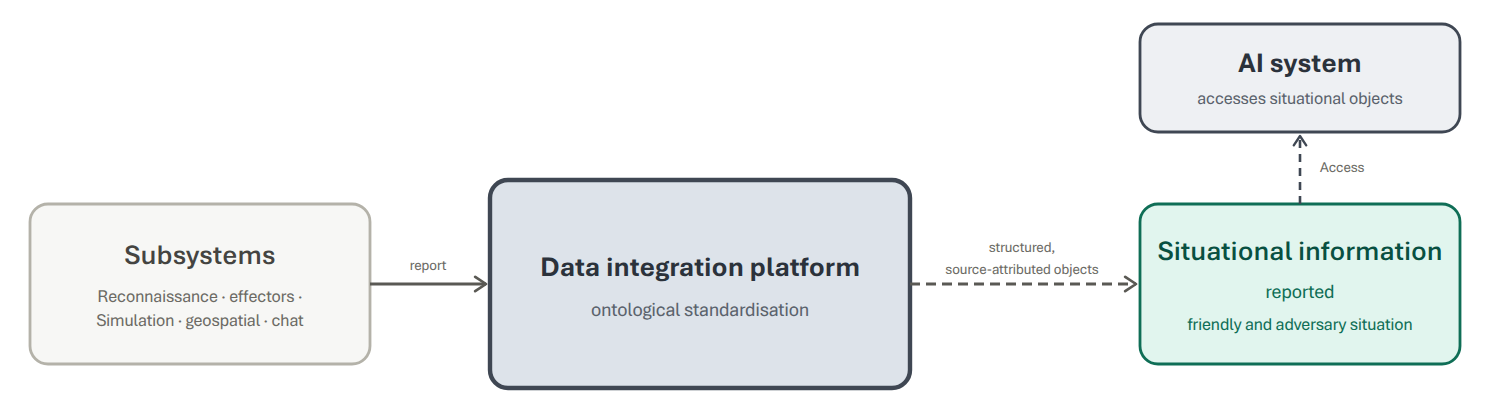
Reports from all connected subsystems converge at the command post. They originate from reconnaissance and effector systems as well as weather, geospatial and command-and-control information services. The AI requires access to these reports if it is to support the staff, but connectivity alone is insufficient. An individual report states only what has been observed, not what that observation means. The AI must be able to interpret the report, including whether it refers to a vehicle or a formation, how reliable it is and how it relates to other reports.
This is precisely the task of a data integration platform (DIP). It receives reports from all subsystems, structures them and makes them interpretable. The DIP therefore forms the connecting layer between the subsystems and the AI system while also providing the command post’s common situational database. Rather than reporting in isolation, each subsystem feeds its reports into the DIP.
The DIP translates reports from different subsystems into a common language so that they can be correlated. It maps every incoming item to a uniform semantic structure. This ontology defines what an object is and how it is described. On that basis, the DIP recognises when several reports concern the same real-world object, fuses them and attaches provenance, confidence, currency and protection requirements.
NATO nations have spent years standardising the exchange of land command-and-control information and have made it binding for their federated mission networks. The result is the MIP4 Information Exchange Specification. The required ontology therefore already exists; national subsystems only need to be connected to it. It covers the core of command-and-control information, though not every conceivable source. Specialised systems, including analysis and simulation systems, require extensions for which the ontology was specifically designed.
The DIP supplies the AI system with situational information in a structure against which the staff’s assumptions and assessments can be referenced. Together with doctrinal knowledge and staff-generated knowledge, this gives the AI access to all three elements of the knowledge base.
Local AI, Hardware and Models as the Operating Framework
The continuous battle rhythm must not depend on a permanently stable broadband connection. The AI must therefore be capable of operating locally at the command post. At the same time, the command post can no longer be treated as a single, compact location. Its signature, detectability and vulnerability favour dispersing staff cells across terrain, existing infrastructure or settlements while maintaining their ability to function as a common command-and-control space.
The AI must therefore operate as a distributed local system comprising AI nodes located close to the cells, servers and high-performance workstations, all of which access the same situation and staff-work directory. AI support follows the dispersed command-post structure rather than being concentrated in a technical centre. Under normal operating conditions, fibre-optic links connect the cells. If a link fails, the isolated cell continues working from its local copy; once connectivity is restored, the divergent versions must be reconciled in a controlled manner.
Local AI forms one tier of a wider operating model. Rear-area or home-based AI infrastructure remains necessary for model maintenance, evaluation, approval and particularly compute-intensive analyses. From this infrastructure, the command post requires locally deployable capabilities that remain operational when connectivity is limited, bandwidth is constrained or security regulations are restrictive, and that can be synchronised periodically. The priority is robust availability for clearly bounded tasks rather than maximum on-site model performance.
This approach deliberately differs from platform-centric solutions that model situational information and staff-generated knowledge together within a central object ontology. Which approach will prove superior under combat conditions remains an open question.
Preconditions, Risks and Human Command Responsibility
Making staff-generated knowledge accessible must meet two requirements. It must reduce the staff’s workload by maintaining the command context largely automatically, while also indicating where human assessment, formal approval or a command decision is required. Automation must therefore preserve the staff’s control over its generated knowledge and prepare it in a way that enables human command responsibility to be exercised more effectively. Not every meeting has to be recorded, but assumptions and assessments made, approvals granted and tasks assigned must be captured in a form that both the staff and the AI can trace.
This is also where the principal risk lies. An unclear state of work, outdated metadata or incorrect relationships may cause the AI to produce apparently coherent output that is not professionally sound. The danger is therefore not confined to an incorrect answer; it also includes a seemingly plausible basis for further staff work. Provenance, responsibility and protection requirements must remain visible. Their purpose is to enable the staff to review and validate decisive assessments when necessary, not to turn staff officers into directory administrators.
Human command responsibility remains paramount. The benefit lies in continuous interaction between humans and the system, not in transferring responsibility. AI does not eliminate uncertainty; it makes conflicting assessments and changing assumptions visible and actionable at an earlier stage. Decisions remain a command responsibility. This also creates a training requirement: command personnel must be able to review AI-generated output critically, demand traceability to sources and recognise model limitations. Effective use of AI at the command post thus becomes part of modern staff discipline.
Conclusion
A capable model alone provides only limited improvements to command-post operations. AI must be able to access the staff’s knowledge base. For doctrinal knowledge and situational information, this is a matter of connectivity. Staff-generated knowledge, by contrast, is not yet available in a machine-accessible form. Creating that form is the central challenge, and the AI-readable situation and staff-work directory provides it.
This leads to an architectural choice. The data integration platform consolidates situational information centrally because a common picture can emerge from individual reports only when they are brought together. Staff-generated knowledge remains decentralised and in an open format. The staff must be able to review it, and it must remain available when connectivity between cells is lost. Platform-centric approaches combine both elements in a central ontology. The approach described here separates them and thereby preserves the staff’s control over its generated knowledge.
The Chief of Defence’s Operational Guidance calls for information superiority to be converted into decision and effects superiority. AI-enabled command-post operations address precisely this requirement. Modern combat demands rapid and judicious action; at the command post, this means producing better results in less time. The staff cannot achieve this on its own. It needs a capable and resilient AI system whose operational value depends on deep integration into the decision-making process. Rapidly developing and fielding this capability is one of the most urgent tasks of our time.