
AI Evolution
The global development of generative AI systems is advancing at tremendous speed. According to an estimate by the non-profit research institute Epoch AI, global AI capabilities are currently increasing fourteenfold per year. This affects not only the AI algorithms themselves, but also their architecture and computing power. By way of comparison, while the computing power of conventional computers has in recent years “only” doubled every 18 months, the rapid growth in AI capabilities means that AI models which only a few years ago could be operated only in large data centres can already run today on AI-enabled edge devices.
The world’s leading tech companies, along with a limited number of disruptive AI start-ups, are setting the pace of this development. Their applications, however, are predominantly civilian in nature and therefore offer only limited military utility when taken “off the shelf”. From a military perspective, the task is to assess both the potential and the limits of AI systems for current and future applications. The findings available from the war in Ukraine provide a basis for this.
Findings from the War in Ukraine
“On the battlefield I did not see a single Ukrainian soldier.[…] Only drones, and there are lots and lots of them. Guys, don’t come. It’s a drone war.”
Surrendered Russian soldier
The war in Ukraine painfully demonstrates that the innovation race described above is taking place not only at the industrial level, but also on the battlefield. The technological developments that have emerged from this have led to drastic changes in warfare and to new requirements in connectivity and tempo. Both the development of new weapon systems and the automation of battlefield processes themselves are advancing at high speed. To protect their own forces, soldiers are increasingly being substituted by unmanned systems. Technologies such as artificial intelligence create the preconditions for this.
A good example is the “Delta” system developed by Ukraine for coordinating reconnaissance and strike missions. Delta processes data from drones, satellites, and other sensors in real time, uses AI algorithms to analyse enemy movements, and thereby enables precise artillery strikes. The ability to identify targets automatically and coordinate attacks has significantly increased the effectiveness of the Ukrainian defence. AI-supported image-recognition systems are also being employed in order to identify and prioritise enemy vehicles and positions automatically.
The use of AI technology on the battlefield has therefore long since become reality. Initial capabilities in the areas of target recognition and navigation have been implemented successfully. It is to be expected that these will be expanded rapidly and transferred to additional platforms and systems. New fields of application will also be opened up. From Ukraine’s perspective, it is necessary to think further ahead and create an environment in which new developments can be integrated continuously in constant alignment with operational requirements. Only in this way can it be ensured that, despite continual adaptation and further development, a high degree of integration is maintained and new, innovative systems can be incorporated successively.
The Battlefield of the Future from the Perspective of the Land Forces
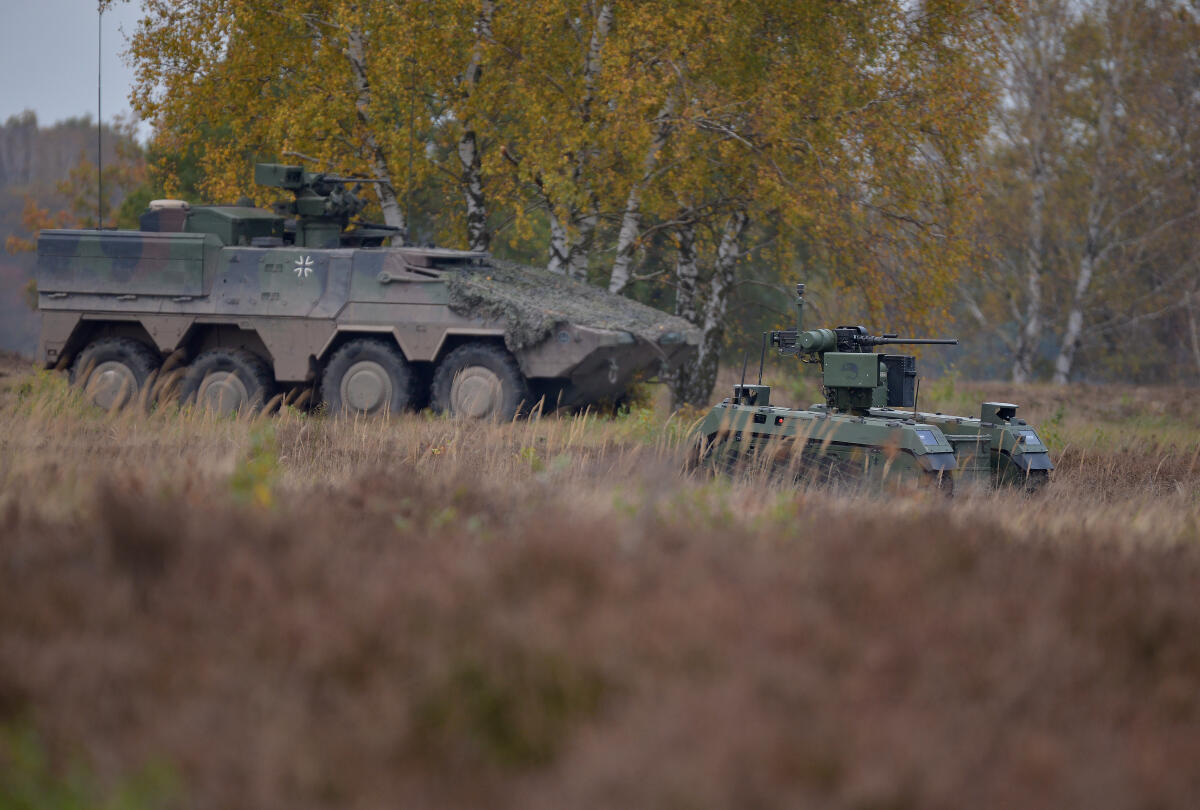
The continuous development of military capabilities in peacetime is essential in order to preserve competitiveness in the international environment. This applies in particular to disruptive technological advances such as the use of unmanned systems and the integration of artificial intelligence. For the German Land Forces, this means making up now for lost ground in the provision of corresponding capabilities, or in defending against them, and developing at an early stage a clear understanding of future requirements. This makes it possible to steer their own development and procurement processes in a targeted manner. The following remarks outline current considerations regarding this complex of issues.
Changed threat situation: The battlefield of the future will be shaped decisively by comprehensive automation and swarming capability. The main threats are posed by unmanned systems in the lower airspace and by long-range weapon systems. Threats from the electromagnetic spectrum are no less dangerous. In order to meet these identified challenges, rapid, critical decisions in dynamic operational environments are indispensable.
Operational implications: The focus is shifting to precision and effectiveness in depth, which requires highly flexible command-and-control systems. The new priority lies in stand-off capability and a high first-round hit probability, while the close-range tactical engagement recedes into the background. Resilient command capability and robust, forward-echeloned combat support are crucial to successful combat operations.
Key technology, artificial intelligence: The Land Forces must be aligned consistently with highly mobile combined-arms combat. The integration of artificial intelligence is a central building block for coping with growing complexity. The aim must be to strike a balanced relationship between rapid implementation and robust application, with the concept of Software Defined Defence providing the necessary framework for development.
Even though this depiction traces only very broad lines, it nevertheless provides a good overview of the manifold challenges in the forthcoming transformation of land-based forces. The trigger is the new threat situation that must be addressed in future. Weapon systems currently in service, supplemented by new capabilities, must be reordered with regard to their significance in combat. The unchanged requirement to achieve high combat power through the interaction of all forces remains unaffected. The immense potential of artificial intelligence for the Land Forces of the future has been recognised. Unlocking it constitutes one of the greatest challenges of the coming decade.
Requirements for AI Development in the Land Domain
AI applications are particularly efficient in solving problems that are considered “inside the box”, that is, tasks that can be solved on the basis of a high-quality data foundation and targeted training. The actual challenges for military leaders on the battlefield, however, often lie in solving “outside the box” problems, especially in unclear situations in which battle-decisive decisions must be made. This is where the rapidly increasing number of sensors in all dimensions, the rapid transmission of the data gained or of evaluation results already generated on the sensor platform, and the automated correlation of data to consolidate the operational picture come into play. The “fog of war” will change, but it will remain. We can decide the race to engage enemy forces, including in depth, in our favour only through the use of AI. Robust integration of AI on the battlefield therefore requires close linkage with operational requirements. The maxim for developing AI applications must accordingly be to think consistently “from the operation outward”. Irrespective of this, AI applications can deliver diverse added value in combat, and unlocking this will become a focus in the years ahead.
In highly mobile combined-arms combat, the human is increasingly becoming the limiting factor. He or she must be supported as effectively as possible in the fulfilment of the respective task by AI-enabled systems. Command and control, reconnaissance, effects, and support are all affected alike. Particular priority should be assigned to AI-based support of the decision-making process and to optimisation of the sensor-to-shooter chain. Especially in highly dangerous and time-critical tasks, improvements should be sought that enable the human primarily to assume supervisory functions.
An AI agent is a computer program based on artificial intelligence that can autonomously perform complex tasks on the operator’s instruction. In contrast to simpler AI such as chatbots, which respond to prompts, AI agents can also operate outside a specific context. They can independently devise strategies in order to achieve an overarching goal and break that goal down into smaller, manageable tasks. The basic mode of operation of an AI agent rests on a triad:
Perception: The agent captures data from its environment by means of sensors.
Processing and decision-making: The agent analyses the perceived data in order to assess the state of the environment and derive the optimal course of action.
Action: The agent performs a physical or digital action in order to affect the environment and accomplish its task.
An AI agent can function as an integral component of unmanned systems, for example for autonomous reconnaissance missions, logistical support, or the analysis of large volumes of data. Its ability to make decisions independently enables it to carry out defined tasks efficiently and without constant human control.
In future, the Bundeswehr could field hundreds, if not thousands, of different AI agents. These must be developed and trained specifically for their respective tasks. Practically every sensor, every weapon system, every combat vehicle, and every command post and operations centre would have specialised AI agents. In combat, these systems would interact independently and exchange data and insights automatically, without any need for human intervention. AI technology as a purely stand-alone solution will not be able to deliver the desired added value. Rather, AI agents must always be conceived and realised in conjunction with other capabilities in order to exploit the full advantage in speed and performance.
To avoid undesirable developments and isolated solutions, new AI developments must be tested continuously within the existing system-of-systems and integrated step by step. The System Centre for Digitalisation in the Land Domain, which is currently being established, provides the basis for this and should be oriented consistently toward the development and integration of new AI capabilities in the Land Forces.
Current AI Activities

The starting point for all efforts is the set of AI evaluations currently being implemented and planned. These consist of eight AI studies, some of which build on one another and support each other.
Both classical deep-learning approaches and generative AI approaches are being examined. The focus lies on the development of demonstrators that enable the operator to assess the extent to which the approaches being pursued deliver operational advantages. Wherever possible, real systems are to be included in the investigations. The high tempo of civilian AI development is also driving military investigations forward rapidly. Modern AI systems capable of reasoning, for example, are increasingly able to draw logical conclusions from a given context. Based on the body of experience thus gained, the next steps for successful armament development are to be derived.
Outlook
Harnessing advances in artificial intelligence will significantly shape the further development of military capabilities. For the Land Forces, this means that comprehensive AI support will be required to meet future demands for speed and precision in combat. This support must be built up rapidly. Although challenges still remain in the fields of digitalisation, mastery of data, and training in the handling of AI systems, we are proceeding at all times in close alignment with operational requirements. When integrating new AI capabilities, it must always be assessed whether any curtailment of the military commander’s decision-making authority is tolerable or even desirable.
The capabilities of the Land Forces must continue to be strengthened. Particular importance must be attached here to the development and employment of future technologies. Special attention must therefore be devoted to the key technology of artificial intelligence, which acts as a catalyst across all areas. The AI expertise already available must be further built up and expanded.
Keeping pace with civilian AI development and rapidly transferring newly developed methods there into military use will remain a major challenge for years.